
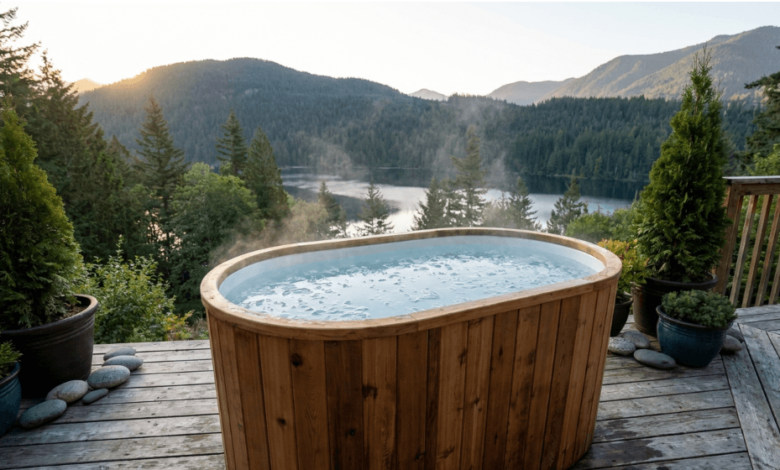
Whether a beginner needs 240V depends entirely on the specific chiller being ordered, not on the tub itself. Smaller chillers built for compact single-person tubs are often designed for standard 120V service at 15 or 20 amps, while larger or faster-cooling units, especially those built for two-person tubs, typically require 240V and won’t run at all on a household outlet. Rather than a single blanket answer, here’s how that plays out across five situations beginners actually find themselves in.
Scenario 1: You Have a Small Tub and an Existing Outdoor Outlet Nearby
If the plan is a compact single-person tub and there’s already a weatherproof outdoor outlet within reach, a 120V-rated chiller might genuinely work without any new wiring, provided that outlet isn’t shared with other high-draw devices like a pressure washer or an outdoor heater. Even so, most manufacturers still recommend a dedicated circuit rather than sharing one, since a chiller cycling on and off can trip a breaker that’s already close to its limit, and repeated nuisance trips shorten a compressor’s working life over time. Confirm the chiller’s exact amperage draw against what that outlet’s circuit can actually spare before assuming it’s plug-and-play.
Scenario 2: You’re Adding a Two-Person Tub to a Garage With Other Big Appliances
A two-person tub generally pairs with a larger chiller, often three-quarter horsepower or more, and units in that range are commonly built specifically for 240V rather than offered in a 120V version at all. If the garage already runs a dryer, an EV charger, or a shop compressor, a load calculation matters even more here, since stacking a new 240V chiller circuit onto a panel that’s already carrying other big draws is exactly the situation where a subpanel sometimes becomes necessary. This is worth confirming with an electrician before ordering a specific tub and chiller combination, not after it arrives and won’t fit the available capacity.
Scenario 3: You’re Renting and Can’t Add Permanent Circuits
Renting doesn’t automatically rule out a cold plunge, but it does narrow the realistic options. Sticking with a 120V-rated chiller that can run off an existing, appropriately rated outlet avoids the bigger step of adding a permanent new circuit, which most leases don’t allow without written landlord approval anyway. Getting that approval in writing before ordering equipment, even for something that seems as simple as plugging into an existing outlet, avoids a dispute later if a landlord objects to continuous appliance use on a circuit they didn’t know about.
Scenario 4: You’re Building New Construction or a Major Renovation
This is the easiest scenario by far, since a 240V circuit can simply be planned into the electrical rough-in alongside everything else, at a fraction of the cost of adding one later to finished walls or a finished yard. Anyone in this position should ask their electrician to size the circuit generously enough to cover a larger chiller than the one currently being considered, since upgrading a tub later is far cheaper than pulling a new circuit through a wall that’s already closed up.
Scenario 5: You Live Somewhere With Strict Permit Enforcement
Most jurisdictions require a permit for a new circuit, particularly one serving equipment near standing water, regardless of whether it ends up being 120V or 240V. In an area known for strict enforcement, budgeting for that permit and inspection from the start, typically a modest fee plus some scheduling delay, avoids a surprise later if a neighbor complaint or an unrelated inspection brings an unpermitted circuit to a building department’s attention. A straightforward new circuit with available panel capacity nearby commonly runs $350 to $900 including materials and labor and the permit itself; a longer run requiring trenching or a subpanel can climb toward $1,500 to $2,800.
What Happens If You Guess Wrong Before Ordering
Guessing on voltage is one of the more expensive mistakes a beginner can make, since a 240V-only chiller simply won’t power on when plugged into a 120V outlet, and a 120V unit run on an improvised 240V adapter risks damaging the compressor outright and voiding the warranty in the process. Either mistake usually means the tub sits unusable for however long it takes to correct the wiring, which can stretch into weeks if a new circuit turns out to be necessary and an electrician’s schedule is booked out. Confirming the exact voltage requirement against your panel before the tub ships, rather than after a delivery truck has already dropped it in the driveway, is the cheapest step in this entire process and the one most often skipped.
Checking Amperage Before You Choose a Model
Across all five scenarios, the deciding document is the same: the specific chiller’s electrical spec sheet, not a general assumption based on tub size. Voltage and amperage requirements vary meaningfully between brands even at similar tub sizes, so it’s worth comparing those numbers directly against your panel’s available capacity before ordering. You can check voltage and amp draw specs across different tub and chiller pairings in SweatDecks’ lineup before calling an electrician, which makes that first conversation more specific and usually faster.
What GFCI Protection Means in Any of These Scenarios
Regardless of voltage, any circuit serving equipment near standing water needs ground-fault protection under most electrical codes, and chiller manufacturers typically require GFCI protection in their installation manual even where local code enforcement might not specifically catch its absence. A GFCI breaker cuts power quickly if it detects current leaking to ground, which matters directly because a chiller sits right next to a large volume of water that someone is standing in. This isn’t a corner worth cutting in any of the five situations above, whether the circuit is 120V or 240V, permitted or not.
Frequently Asked Questions
Do all beginner cold plunge tubs require 240V? No. Many entry-level chillers built for single-person tubs run on standard 120V, while larger or faster-cooling units typically require 240V and won’t operate on a household 120V outlet.
Can a beginner plug a chiller into an existing outdoor outlet? Only if the chiller is rated for 120V at 15 or 20 amps and the outlet isn’t shared with other high-draw devices, and even then a dedicated circuit is usually recommended.
Does a rented home rule out a 240V cold plunge setup? Not automatically, but it usually means sticking with a 120V-rated chiller and getting written landlord approval before any electrical work.
Is a permit really necessary for a new cold plunge circuit? In most areas, yes, since new circuits for equipment near standing water typically require a permit and inspection regardless of voltage.
References
- Effects of cold-water immersion on health and wellbeing: A systematic review and meta-analysis, PLoS One, 2025
- Effects of cold water immersion after exercise on fatigue recovery and exercise performance: meta analysis, Frontiers in Physiology, 2023
- Cold-water immersion (cryotherapy) for preventing and treating muscle soreness after exercise, Cochrane Database of Systematic Reviews, 2012